Ghana’s fifth World Cup: A journey to redemption

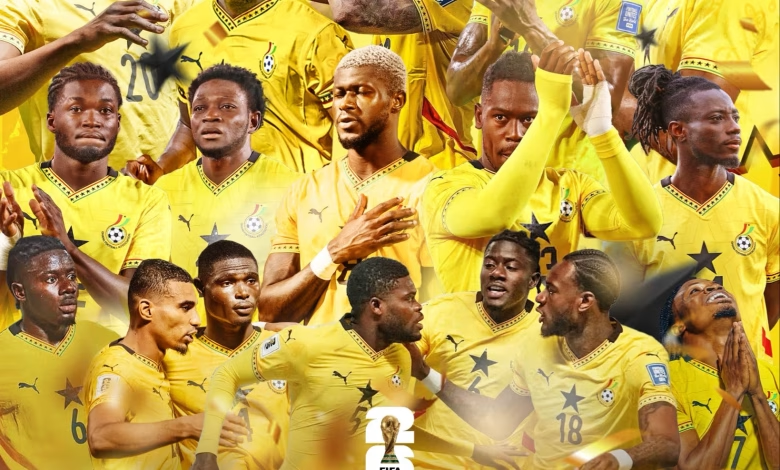
The roar of about 35,000 voices echoed through the Accra Sports Stadium as the final whistle blew. Ghana had done it, the Black Stars were heading to their fifth World Cup. But as the celebrations erupted, the jama intensified and flags waved in the Accra night, one question hung in the air like the smoke from a thousand fireworks: can this generation finally do what Asamoah Gyan’s couldn’t?
It’s been fifteen years since that moment, you and I know the one. July 2, 2010 at Soccer City, Johannesburg. Luis Suárez’s hand, Gyan’s penalty hitting the crossbar. Africa’s dream dying in the cruelest fashion imaginable. Ghana was 120 seconds away from becoming the first African nation to reach a World Cup semi-final. Instead, they went home carrying the continent’s broken heart.
That night haunts Ghana still, every tournament since has been measured against that quarter-final. Every new generation of players has been asked the same question: Are you the ones who will finally heal that wound?
This squad is different, led by regulars Thomas Partey, Mohammed Kudus, Jordan Ayew, Antoine Semenyo, and Benjamin Asare. Ghana’s 2026 team represents perhaps the most talented collection of players the nation has assembled since 2010.
Mohammed Kudus, who now has 45 caps for Ghana, has become the heartbeat of this team and has even been nicknamed “star boy” by fans. Playing for Tottenham Hotspur in the English Premier League, he brings a creativity and flair that recalls the golden days of Ghanaian football, his confidence is infectious. Speaking to Sports Illustrated, Kudus didn’t shy away from the comparison with 2010: “2010 we went all the way to the quarterfinals. And I believe this squad can even do more than that.”
Those words carry weight, this isn’t just hope, it’s conviction from a player who has carried Ghana’s attacking burden on his shoulders.
Thomas Partey, currently with Spanish side Villarreal, provides the steel and leadership in midfield that every World Cup campaign needs. But talent alone doesn’t make history, the 2010 squad was talented too and some may say even more talented than this team.
So was the 2006 team that captured the world’s imagination as the tournament’s youngest squad and getting far in the tournament. Yet neither could climb higher than the quarter-finals.
Ghana’s World Cup story has been one of near misses and crushing disappointments. In 2006, they announced themselves to the world, the only African nation to escape the group stages. By 2010, they were genuine contenders, playing with a fearlessness that had Brazil worried and Uruguay desperate. Then came 2014’s group stage exit amid internal chaos, and 2022’s heartbreak of elimination on goal difference.
Each tournament carved a deeper groove of expectation into the national consciousness. Each failure made the dream of a semi-final seem more distant, more impossible. The question isn’t whether this generation is talented enough. The question is whether they can carry the weight of twenty years of history and still fly. Whether Otto Addo has the tactical brain of Ratomir Dujkovic and Milovan Rajevac to set the Black Stars shining.
The 2026 World Cup will be different from any that came before. With 48 teams instead of 32, the path to glory opens wider. More matches mean more opportunities. More opportunities mean fewer margins for error become fatal wounds. But perhaps the biggest difference is this: the 2010 generation went to South Africa believing they could make history.
This generation goes to North America knowing they must. Ghana failed to qualify for the 2025 Africa Cup of Nations, a shocking disappointment that could have shattered team morale. Instead, it seems to have focused them. The qualification campaign has been nearly flawless, dominant even. A statement victory over Central African Republic. Clinical performances when it mattered. And now, qualification secured with the kind of efficiency that winners possess.
Somewhere in Ghana tonight, a young fan is wearing a Black Stars jersey and dreaming of July 2026. They’re dreaming of Kudus dancing through defenses, of Partey controlling the game’s tempo, of Semenyo’s pace terrorizing opponents and hoping Jordan will keep on scoring as he did in the qualifiers. They’re dreaming of what Gyan couldn’t quite reach. But they’re also remembering, remembering 2010’s heartbreak. Remembering 2014’s chaos. Remembering 2022’s so close yet so far elimination.
Every Ghanaian fan carries these memories like stones in their pockets. Heavy, but impossible to leave behind.
Can this squad surpass the quarter-finals? Can they write a new chapter where Ghana finally becomes the second African nation to reach a World Cup semi-final after Morocco? The talent is there, the motivation is there. The opportunity is there.
Fifteen years ago, Ghana stood on the precipice of history and watched it slip through their fingers in the most painful way imaginable. In 2026, they’ll get another chance. Another opportunity to prove that sometimes, the weight of history doesn’t crush you. Sometimes, it makes you stronger.
The question isn’t whether this generation can surpass the quarter-finals.
The question is whether they’re ready to become legends.
Ghana’s fifth World Cup journey begins in 2026. The world will be watching. Africa will be hoping. And 35 million Ghanaians including that little fan somewhere in Ghana wearing a jersey in his room will be believing that maybe, just maybe, this is finally their time.