The draw for the 2026 FIFA World Cup has set the stage for what promises to be a thrilling and highly competitive tournament, particularly for Africa’s representatives, who will be eager to leave a strong mark on the expanded global showpiece.
With a record number of African teams qualifying for the tournament, optimism across the continent is high. However, while opportunity abounds, the road to the knockout stages will be anything but straightforward. Here is a breakdown of how each African side fared in their respective groups.
Group A: South Africa
South Africa have been handed a balanced but tricky Group A alongside hosts Mexico, Korea Republic, and the winner of Play-off D. Mexico’s home advantage and Korea’s tactical discipline will pose stern tests, but South Africa’s recent resurgence offers hope. A positive start will be crucial if Bafana Bafana are to keep their knockout ambitions alive.
Group C: Morocco
Fresh from their historic semi-final run at the 2022 World Cup, Morocco enter Group C with Brazil, Haiti, and Scotland. Brazil are clear favourites, but Morocco’s defensive solidity and tournament experience make them strong contenders for second place. This draw provides the Atlas Lions with a realistic pathway to the knockout stage.
Group E: Côte d’Ivoire
Côte d’Ivoire find themselves in Group E with Germany, Ecuador, and Curaçao. Germany remain the standout challenge, but Ecuador’s physicality and Curaçao’s unpredictability mean there will be no easy fixtures. The Elephants’ pace and power will be vital in what is a tougher group than it appears on paper.
Group F: Tunisia
Tunisia face a demanding task in Group F alongside the Netherlands, Japan, and the winner of Play-off B. Japan’s high tempo and the Dutch side’s technical quality will test Tunisia’s organisation and resilience. Progression will likely require near-perfect execution and ruthless efficiency in key moments.
Group G: Egypt
Back on the World Cup stage, Egypt line up in Group G with Belgium, Iran, and New Zealand. Belgium remain the group favourites despite an ageing core, while Iran are traditionally tough opponents at World Cups. Egypt’s defensive structure and attacking creativity could give them a strong chance of finishing second if they deliver consistent performances.
Group H: Cabo Verde
World Cup debutants Cabo Verde face arguably one of the toughest draws, placed in Group H with Spain, Uruguay, and Saudi Arabia. Against three established tournament regulars, Cabo Verde’s discipline and growing confidence will be tested to the limit. Any points gained would represent a historic achievement for the island nation.
Group I: Senegal
Senegal, one of Africa’s strongest hopes, headline Group I alongside France, Norway, and the winner of Play-off 2. A rematch with France is the standout fixture, while Norway’s physicality and intensity will also pose problems. Still, Senegal’s experience and quality give them a genuine chance of advancing if they start strongly.
Group J: Algeria
Returning to the global stage, Algeria have been drawn in Group J with Argentina, Austria, and Jordan. Reigning champions Argentina are favourites, but Algeria will back themselves against Austria and Jordan. Their technical quality and tactical flexibility could pave the way to a top-two finish if they avoid slow starts.
Group K: Winner of Play-off 1 (Potential African Representative)
Should an African nation claim Play-off 1, they will enter Group K alongside Portugal, Colombia, and Uzbekistan. While challenging, the group is not impossible. A disciplined and well-organised African side could compete for qualification with belief and momentum.
Group L: Ghana
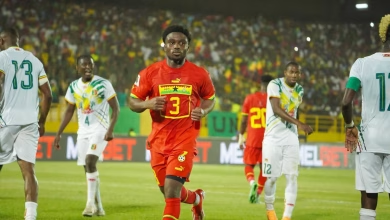
Ghana face a heavyweight challenge in Group L against England, Croatia, and Panama. England boast world-class depth, while Croatia’s midfield remains elite and tournament-hardened. Ghana will need exceptional performances to progress, with the clash against Panama likely a must-win encounter to keep qualification hopes alive.
Africa’s Outlook
Africa’s road to the knockout stages at the 2026 World Cup promises drama, challenge, and opportunity. Morocco, Senegal, and Egypt appear to have the most favourable routes, while Cabo Verde and Ghana face steeper climbs.
Ultimately, success will depend on preparation, momentum, and the ability to seize defining moments. With greater representation than ever before, Africa enters the 2026 World Cup with renewed belief, and a genuine chance to make history once again.